Phenylbutazone (PBZ), commonly known as Bute, can be the horse
owner's (and horse's) best friend. This popular and economical
non-steroidal anti-inflammatory (NSAID) blocks pain, reduces
swelling and inflammation, and lowers fever, making it an
effective choice for treating injuries, infections, and
musculoskeletal disorders such as laminitis, navicular disease,
arthritis, and degenerative joint disease. Plus, Bute can
deliver the goods for more than 24 hours.
But there is a downside: Generally a safe product when used
as directed for most horses, Bute does have a narrow safety
margin and, in certain individuals, can cause serious and even
fatal side effects, warns Patricia Dowling, DVM, MS, Dipl. ACVIM,
ACVP (pharmacology), professor of veterinary clinical
pharmacology at the Western College of Veterinary Medicine
(University of Saskatchewan) and director of Western Centre
Canadian GFARAD (Global Food Animal Residue Avoidance Databank).
Although underlying
causes of Bute sensitivity in some individuals go undetermined
or undiagnosed, horses at most risk are foals, performance
horses that travel, ponies, aged horses, dehydrated horses, and
those with hypoproteinemia (low protein blood levels), liver or
kidney disorders, or rhabdomyolysis (tying-up).
The most common side
effects of Bute toxicity, Dowling says, are oral ulcers (open
sores or lesions in the mouth) and right dorsal colitis (a
life-threatening, ulcerative inflammatory condition of the
colon). Bute toxicity can also cause ulcers or hemorrhages in
the esophagus and gastrointestinal tract, diarrhea, low white
blood cell count, anemia, and intestinal, kidney, and liver
disease. "The kidney effects are usually clinically silent,
unless you look for it with ultrasound," Dowling says. "With
high doses of Bute in really dehydrated horses, you can see
outright kidney failure."
The incidence of Bute toxicity is unknown, but it might be
fairly common, says Rebecca S. McConnico, DVM, PhD, Dipl. ACVIM,
assistant professor of equine medicine in Louisiana State
University's Equine Health Studies Program. "Here at our
teaching hospital, we may see one or two horses a month where
there is concern that the horse is presented with signs
consistent with Bute (or other NSAID) toxicity," she says.
"Furthermore, there are likely many unidentified (subclinical)
cases of Bute toxicity."
How Bute Works
Phenylbutazone is absorbed well from the stomach, but most of
the dose of Bute remains in the blood and does not cross
biological membranes well, Dowling explains. "The highest
concentrations are in the liver, heart, kidney, lungs, and
plasma, with low levels in normal tissues and joint fluid," she
says. However, when tissues or joints are damaged, increased
blood flow and the leaking of blood fluids from damaged blood
vessels allow Bute levels to increase to therapeutic levels at
these damaged sites.
"Phenylbutazone is converted by the liver to oxyphenbutazone
(OPBZ), a metabolite with the same action as Bute, but that is
removed slower from the body than Bute, so the therapeutic
effect of Bute lasts for more than 24 hours," Dowling continues.
"Less than 2% of the original dose of Bute is excreted in the
urine as an unchanged drug, so liver function is very important
in the elimination of this drug; the capacity of the liver to
process Bute becomes overwhelmed at relatively low drug doses.
Therefore, increasing doses of Bute can easily result in
toxicity."
Bute is available in many intravenous and oral formulations
(powder, paste, gel, tablets). "The injectable formulation must
be given by careful intravenous injection, otherwise it causes
severe tissue damage if given intramuscularly or
subcutaneously," Dowling states. "Orally administered Bute is
well absorbed, but the time it takes to reach peak blood levels
is delayed by feeding the horse, as the Bute sticks to feed
particles in the horse's gut."
Dosage varies somewhat depending on severity of pain or
inflammation. "Routine lame horses (average horse weighing about
1,000 pounds or 450 kilograms) usually receive a dose of about 1
gram twice a day (2.2 mg/kg) initially over a five- to 10-day
period," McConnico says. "However, it is not unusual for a horse
to receive twice that daily dose. In fact, many veterinary
textbooks and acceptable dosage recommendations are as high as
4.4 mg/kg twice a day, which is 4 grams a day."
While Bute is labeled for use at up to 4 grams per 1,000
pounds of body weight per day (for which many give 2 grams every
12 hours), Dowling recommends once daily dosing of 2 grams/1,000
pounds to allow as much Bute and OPBZ as possible to be
eliminated before giving more. "As soon as possible, I get them
on every-other-day therapy. For chronic use, I try to give it
every three or four days," she says. "If the horse's condition
is so painful that a higher dose would be needed, then I
recommend using a different NSAID with a higher safety margin."
Bute Gone Wrong
NSAIDs like Bute reduce pain and inflammation by blocking
chemicals known as prostaglandins that are released by damaged
tissues. While controlling these inflammatory prostaglandins is
a beneficial effect, unfortunately there are other
prostaglandins that are produced by normal tissues. These "good"
prostaglandins have normal housekeeping functions in the body:
They regulate blood flow to the kidneys and lining of the
gastrointestinal tract, and mucus production in the stomach.
Toxicity from Bute and other NSAIDs occurs when these "good"
prostaglandins are blocked along with the inflammatory
prostaglandins.
"Bute is more toxic than other NSAIDs because most of the
drug stays in the blood after administration," Dowling explains.
"Therefore, it easily blocks the 'good' prostaglandins,
resulting in reduced blood flow to the kidneys and GI tract and
decreased mucus production in the stomach. This causes the
kidney damage and the ulcers throughout the GI tract.
"Dehydration makes the toxicity problem worse," she adds. "As
most of the Bute is in the bloodstream, when the horse is
dehydrated, the Bute concentration will be higher. So a 'normal'
dose to a dehydrated horse can be a 'toxic' dose."
The severity of gastrointestinal ulcers appears to be
dose-dependent, and some horses might have an increased
sensitivity to standard dosing, reports McConnico. "The
incidence of right dorsal colitis subsequent to NSAID treatment
is unknown, but probably occurs in varying degrees in most
horses treated for longer than 48 hours (intravenous route) or
72 hours (oral route) at a dose of 8.8 mg/kg per day."
High doses of Bute can be directly toxic to the liver, and
the liver damage can further decrease the horse's ability to
metabolize and eliminate Bute and OPBZ, compounding the systemic
toxicity.
Side effects from Bute toxicity can show up as early as a
couple of days after starting therapy, or signs might not become
apparent for several days to several weeks. "The onset of signs
may be slow, then a sudden onset of diarrhea, weight loss, or
colic may occur," McConnico says. Other clinical signs include
inappetence, lethargy, and pitting edema (fluid swelling) on the
underside of the abdomen. "Side effects may be long-lasting,"
McConnico continues. "Probably the most common long-term side
effect is chronic colic due to chronic colonic ulceration,
intestinal scarring (stricture formation), or adhesions."
What To Do?
If a horse shows adverse side effects after going on Bute,
discontinue the Bute and consult with a veterinarian
immediately. "The horse should be examined (including blood
work) to determine if toxicity is a possibility," McConnico
states.
Treatment will most likely include supportive care in the
form of intravenous fluids with additional therapies based on
how the Bute toxicity manifests itself.
"Treatment of NSAID gastrointestinal toxicity is intensive
and mainly symptomatic," says Dowling. "The hypoproteinemia that
results from loss of plasma proteins into the ulcerated
gastrointestinal tract can be corrected with intravenous
infusions of plasma. The fluid and electrolyte losses that
accompany diarrhea are managed with commercially available
intravenous fluids. Broad-spectrum antibiotics are indicated
when there is evidence of bacterial septicemia."
"Since gastric ulceration is commonly associated with Bute
toxicity, appropriate oral anti-ulcer medication is indicated,"
McConnico says. "The most effective medication for treatment is
omeprazole (GastroGard from Merial, 4.4 mg/kg once daily). A
lower dose of omeprazole has been recommended for preventative
therapy."
"Surgical removal of damaged sections of stomach or the right
dorsal colon may be necessary in some cases," notes Dowling.
"Recovery is usually slow, and in severe cases the prognosis is
guarded."
If pain management is needed, another form of analgesia such
as butorphanol (an opioid) or xylazine (Rompun, a tranquilizer
with some analgesic effects) will be necessary, McConnico
states. More NSAIDs should not be given because, comprising the
same drug class as Bute, they could irritate rather than
alleviate toxicity reactions.
Dietary management is also important for recovery from Bute
toxicity. Dowling recommends a diet high in alfalfa and corn
oil. Studies show that the calcium content in alfalfa hays acts
like a buffer and helps raise the stomach's pH (making it less
acidic), while corn oil contains anti-ulcer properties.
A horse that has a Bute reaction once could have an adverse
reaction again, if all the contributing factors are in place
again, Dowling says. Therefore, future administration of Bute
and other NSAIDs should be closely monitored in horses that have
had problems with Bute.
Avoid Problems
To minimize the risk of a Bute reaction, have your horse
examined by a veterinarian prior to using the drug, suggests
McConnico, so the normal appearance, heart rate, temperature,
and breathing rate of the horse is known. Monitor the horse's
attitude, appetite, manure production, and overall appearance
daily when you start administration; if you notice any changes,
don't delay in notifying your veterinarian. Horses treated
long-term with Bute (or another NSAID) should receive a
veterinary exam every seven to 14 days with blood samples drawn
for albumin, total plasma protein, and renal (kidney) function,
McConnico says.
Dose with the lowest effective amount and longest possible
dosing interval, Dowling recommends. "The practice of giving a
gram a couple of times a week to the mature horse with arthritis
is fine and unlikely to cause toxicity," she says.
Always provide a well-balanced, palatable, easily digestible
feed ration since nutritional support of the intestinal lining
and the overall health status is critical, says McConnico. Make
sure your horse has plenty of water to prevent dehydration.
Don't use Bute in situations where the horse is--or could
become--dehydrated, such as during an endurance race, three-day
event, long trailer ride, etc., Dowling says. "I ride endurance
horses, and they always have a degree of dehydration after a
race. I never use Bute after a competition."
Consider other pain relievers. "The other available NSAIDs
are all less toxic than Bute and can be used judiciously when
the horse has recovered," Dowling says. "Flunixin meglumine (Banamine),
ketoprofen (Ketofen), and vedoprofen (Quadrisol 100, available
in Canada, but not the U.S.) all stay in the bloodstream a much
shorter time than Bute. However, they all accumulate at sites of
inflammation, giving you effective therapy for 24 hours for
musculoskeletal pain. Because there is less drug in the blood,
there is less drug affecting the kidneys and GI tract. They
don't accumulate to high levels because of saturation of the
elimination mechanisms. The other benefit is that these drugs
are all cleared faster and are less likely to result in positive
drug tests--very important for someone in a 'no drug' sport."
If overdosed, these other NSAIDs can cause the same toxic
reactions as Bute, but one doesn't see many problems with them
in routine clinical use.
Take-Home Message
"The only reason to use Bute instead of another NSAID is that
it is cheap," concludes Dowling. "Here in Canada, Bute costs 17
cents for a 1-gram tablet, while Banamine costs about $17 a
dose. My horses are worth the extra expense for the extra safety
margin. The only place I'd use Bute is in chronic conditions
like laminitis or navicular disease, where therapy is for months
or years; as long as it's low dose and every two or three days,
it's very safe. But for serious pain like colic, rhabdomyolysis,
etc., it's just not worth it to go cheap and use Bute instead of
flunixin, ketoprofen, or vedoprofen."
Whichever NSAID you choose, make sure it is chosen with the
input of your veterinarian. And to minimize the long-term
effects of NSAID use, work with your veterinarian to quickly
recognize and treat any toxicity problems that might arise.









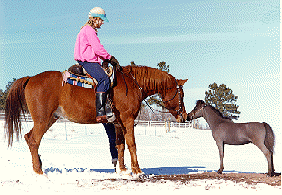 The information contained in this
"Care of Mini Horses" is what we have found from
18 years of experience from
breeding, caring for and loving miniature horses. It is not intended to replace a
veterinarians opinion but to give you food for thought. The vaccination, worming and
feeding information is what we have found works for us. Ask someone else and you are
likely to get a different answer. :-)
The information contained in this
"Care of Mini Horses" is what we have found from
18 years of experience from
breeding, caring for and loving miniature horses. It is not intended to replace a
veterinarians opinion but to give you food for thought. The vaccination, worming and
feeding information is what we have found works for us. Ask someone else and you are
likely to get a different answer. :-)